
Swiss SRO License: Requirements, Costs, Timeline & Market Entry Guide
June 17, 2026


Switzerland remains one of the most attractive jurisdictions for fintech, crypto, and payment businesses looking for a balance between regulatory credibility, operational flexibility, and faster market entry. While full financial licensing under FINMA may be necessary for certain activities, many financial intermediaries choose the Swiss Self-Regulatory Organization (SRO) framework as a more practical path to launching operations.
For crypto exchanges, payment companies, stablecoin projects, custody providers, OTC desks, and digital asset businesses, Swiss SRO license often provides a significantly faster route to becoming operational while maintaining access to one of the world’s most respected financial ecosystems.
This guide explains how Swiss SRO license works, which business models qualify, what limitations exist, expected costs, timelines, and how companies can structure their market entry more efficiently.
What Is Swiss SRO Membership?
Swiss Self-Regulatory Organizations (SROs) are supervisory organizations recognized under Swiss Anti-Money Laundering legislation. Companies conducting financial intermediary activities that do not require direct prudential supervision by FINMA may join an approved SRO instead of obtaining a full financial license.
The Swiss model creates a two-level structure. FINMA supervises recognized SROs, while SROs supervise their members and ensure compliance with Swiss AML requirements.
For many businesses, this creates a middle ground between operating without regulation and pursuing more expensive licensing frameworks.
Swiss SRO membership is commonly used by companies operating in:
- Crypto exchange services
- Payment processing activities
- Fiat and crypto conversion services
- Digital asset custody structures
- OTC brokerage operations
- Token-related services
- Stablecoin projects
- Certain lending activities
- Financial intermediary services
However, SRO membership does not replace full licensing requirements where banking activities, public deposits, investment services, or certain retail-focused operations are involved.
Why Fintech Companies Choose Switzerland
Switzerland combines regulatory predictability with strong international credibility. Unlike many jurisdictions that focus exclusively on either strict regulation or operational flexibility, Switzerland has historically positioned itself between these two extremes.
For fintech companies, this creates several advantages:
Faster market entry compared to many licensing regimes, relatively moderate capital requirements, access to experienced financial infrastructure providers, strong banking reputation, and a mature ecosystem for crypto and digital asset businesses.
For founders evaluating jurisdictions, Swiss SRO membership is often viewed less as a final destination and more as a strategic entry point that allows companies to validate business models before moving toward broader regulatory structures.
Which Businesses Can Operate Under Swiss SRO License?
Not every financial business model fits within the Swiss SRO framework. Qualification depends heavily on transaction flows, custody structures, customer types, and how funds move through the platform.
| Business Activity | SRO Membership Suitable | Notes |
|---|---|---|
| Crypto exchange services | Yes | Structure dependent |
| Fiat payment processing | Yes | Widely used |
| OTC crypto brokerage | Yes | Common use case |
| Crypto custody | Usually | Requires review |
| Stablecoin projects | Sometimes | Depends on structure |
| Retail banking | No | FINMA required |
| Public deposit taking | Limited | Thresholds apply |
| Investment services | Usually no | Licensing review needed |
Because interpretation may vary between SRO organizations, structuring the business model correctly from the beginning often determines whether approval becomes straightforward or difficult.
Swiss SRO Membership vs FINMA License vs MiCAR
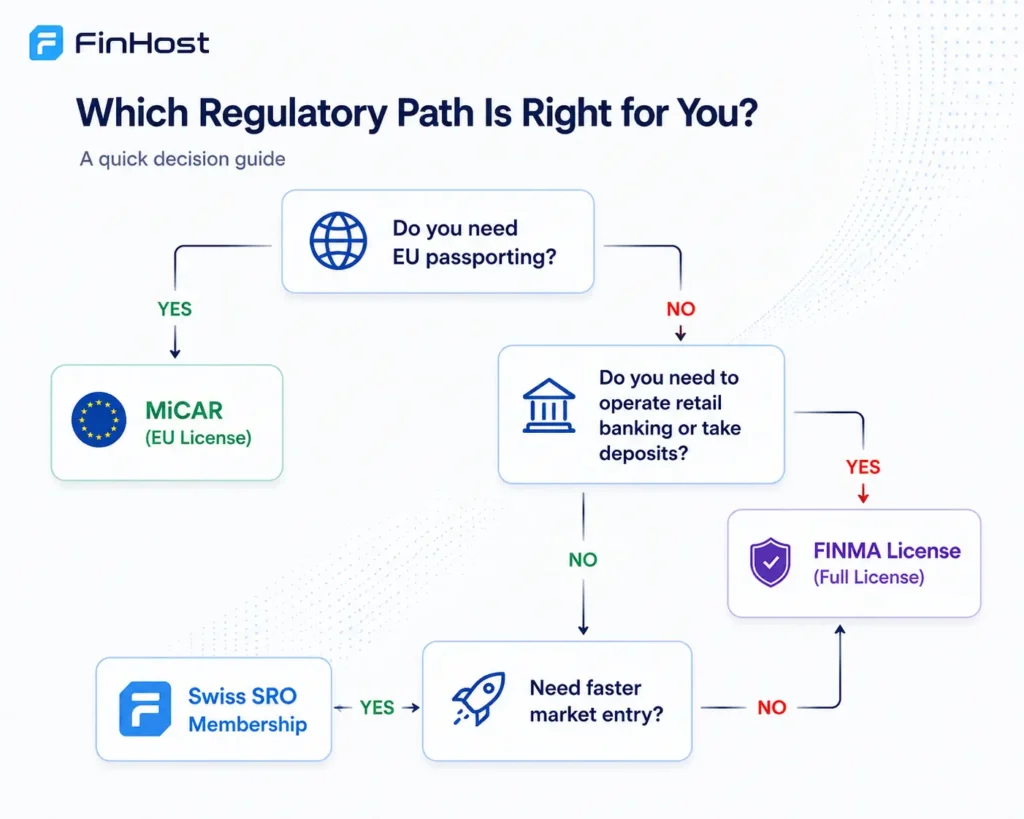
Choosing between Swiss SRO membership, FINMA licensing, and European licensing frameworks depends primarily on expansion plans, customer geography, and business model complexity.
| Factor | Swiss SRO | FINMA License | MiCAR |
|---|---|---|---|
| Launch timeline | 2–4 months | 12–24+ months | 6–18 months |
| Capital requirements | Lower | High | Medium–High |
| EU passporting | No | No | Yes |
| Complexity | Medium | Very High | High |
| Ongoing compliance | Moderate | Heavy | Heavy |
| Best for | Early-stage fintechs | Large institutions | EU scaling |
For many early-stage companies, SRO membership becomes attractive because it allows faster commercialization while maintaining future optionality.
Which Swiss SRO Is Best for Your Business?
Although all Swiss Self-Regulatory Organizations operate under the same overarching regulatory framework, their internal practices, risk appetite, preferred industries, and onboarding requirements can differ significantly.
For fintech and crypto companies, choosing the wrong SRO often creates delays, additional compliance requests, or even rejection despite having a viable business model.
Some organizations are more experienced with digital assets and crypto-related activities, while others focus more heavily on traditional financial intermediaries or professional services firms.
| SRO | Typical Focus | Crypto Friendly | Notes |
|---|---|---|---|
| VQF | Crypto, fintech, payments | High | Frequently used for digital asset businesses |
| SO-FIT | Financial intermediaries | High | Often selected for crypto structures |
| ARIF | Broader financial services | Medium | Large and established |
| PolyReg | Mixed activities | Medium | Flexible in some structures |
| AOOS | Traditional financial activities | Lower | More conservative approach |
The optimal choice depends on customer geography, transaction flows, risk profile, planned products, and long-term expansion strategy.
Swiss SRO Membership Costs Explained
Many founders underestimate the total cost of Swiss market entry because they focus only on incorporation or SRO membership fees. In practice, launching under the Swiss framework requires budgeting for both regulatory and operational components.
| Cost Component | Typical Range |
|---|---|
| Company incorporation | CHF 5,000–15,000+ |
| Legal opinion | CHF 3,000–15,000+ |
| AML framework preparation | CHF 2,000–10,000+ |
| SRO admission fees | Varies by organization |
| Annual SRO fees | Ongoing |
| Local substance requirements | Variable |
| Compliance officer | Ongoing |
| Banking setup | Case dependent |
| Annual audits | Ongoing |
The actual budget depends heavily on business complexity, customer risk profile, expected transaction volumes, and whether the company builds infrastructure internally or uses external providers.
Many businesses reduce operational complexity by combining licensing support with infrastructure providers, compliance outsourcing, and ready-made corporate structures.
How Long Does Swiss SRO Membership Take?
Compared to traditional licensing frameworks, Swiss SRO membership offers considerably shorter timelines.
A typical process may look like this:
Weeks 1–2: Business model assessment and structuring
Weeks 2–5: Company incorporation and substance setup
Weeks 4–8: Compliance framework preparation
Weeks 7–10: Application submission
Weeks 10–16: Review, clarification requests, interview process
Months 2–4: Operational launch preparation
The timeline increases when business models involve more complex custody structures, retail exposure, cross-border services, or unconventional transaction flows.
Common Reasons Swiss SRO Applications Get Rejected
Many rejected applications are not caused by regulation itself but by weak preparation.
The most common issues include unclear transaction flows, poorly documented AML procedures, insufficient local substance, unrealistic business models, incomplete source-of-funds documentation, weak governance structures, or business activities that fall outside SRO scope.
Retail-focused businesses also face additional scrutiny because certain SRO organizations maintain a more conservative approach toward consumer-facing financial services.
Companies that conduct pre-assessment exercises before incorporation often reduce delays significantly.
Can You Serve EU and UK Clients Under Swiss SRO Membership?
Serving European Clients
Swiss SRO membership does not provide European passporting rights because Switzerland is not part of the European Union or European Economic Area.
In practice, this means businesses cannot actively market regulated services across the EU under the same freedoms available through European licensing frameworks.
Some firms operate through reverse solicitation models or initially focus on non-EU markets before expanding.
Companies planning large-scale European growth often treat Swiss SRO membership as an intermediate stage before obtaining additional licenses.
Serving UK Clients
Switzerland and the UK maintain strong financial relationships and mutual recognition arrangements in selected sectors.
However, Swiss SRO membership itself does not automatically grant direct UK market access.
For many fintech companies, the UK strategy depends more on product structure, target customers, and partnership models than on SRO status alone.
Is Swiss SRO Membership Right for Your Business?
The framework works particularly well for businesses that prioritize speed, operational flexibility, and institutional-focused business models.
| Business Type | Recommended Approach |
|---|---|
| Early-stage crypto company | Swiss SRO |
| Payment startup | Swiss SRO |
| Institutional custody provider | Swiss SRO |
| Retail banking project | FINMA |
| EU-focused expansion | MiCAR |
| Large regulated financial institution | FINMA |
The question is rarely whether SRO membership is better than other frameworks. The real question is whether it aligns with the company’s current growth stage.
Ready-Made Swiss Entities and Faster Market Entry
Some companies choose to reduce launch timelines further by acquiring existing corporate structures or using operationally prepared entities.
Ready-made structures may provide advantages such as established corporate foundations, existing operational setup, faster onboarding preparation, and simplified organizational buildout.
While acquiring existing entities does not eliminate compliance requirements, it can significantly reduce operational complexity and accelerate execution.
For founders under investor pressure or aggressive launch timelines, this approach is increasingly becoming part of the market entry strategy.
How FinHost Supports Swiss Market Entry
FinHost supports companies through the full Swiss market entry process by combining regulatory expertise, operational infrastructure, and scalable technology.
For businesses requiring Swiss-based infrastructure, FinHost can also support the deployment of core data layer infrastructure within the Zurich, Switzerland region. This helps companies localize critical technology components while building operations within the Swiss financial ecosystem.
Support may include:
• Swiss market entry advisory
• Ready-made licensed businesses
• Compliance and AML frameworks
• Banking and payment infrastructure introductions
• White-label fintech software
• Crypto and payment integrations
• Source code ownership options
• Ongoing operational support
This approach allows companies to focus on product growth instead of building every component internally.
FAQ
How much does Swiss SRO membership cost?
Total costs vary significantly depending on business complexity, but businesses should budget for incorporation, compliance preparation, legal work, operational setup, and ongoing regulatory obligations.
Can foreign founders own Swiss SRO companies?
Yes. Foreign ownership is possible, although local substance requirements often apply.
Can crypto businesses operate under SRO membership?
Yes. Many crypto-related activities can operate within the SRO framework if structured correctly.
Do you need a Swiss director?
In many cases, local substance requirements apply, which may include Swiss-based representation.
Can actively market services across the EU?
No. Swiss SRO membership itself does not provide EU passporting rights.
How fast can companies become operational?
Well-prepared structures may become operational within several months, depending on complexity and chosen SRO.


