How Do Money Services Businesses Make Money? MSB Revenue Models Explained
November 5, 2026


Money services businesses (MSBs) help individuals and companies move, exchange and manage money. But how do they actually generate revenue? The answer goes beyond charging customers for transfers. A modern MSB may combine transaction fees, foreign exchange spreads and account-related charges. Yet revenue is not profit: banking partners, technology, compliance and operational costs all affect the result. This guide explains the main MSB revenue models, offers practical examples and includes an interactive calculator to explore monthly and annual economics.
What Is a Money Services Business?
A money services business (MSB) provides certain services involving the movement or exchange of money. Definitions differ by jurisdiction. In Canada MSB, FINTRAC identifies activities including foreign exchange dealing, remitting or transmitting funds, and dealing in virtual currencies as activities that can fall within the MSB framework. In the United States MSB, FinCEN has its own definitions and requirements. An MSB is not automatically a bank, and registration does not itself grant banking authorization. The services an MSB can offer depend on its regulatory position, jurisdiction and financial partners.
How Do Money Services Businesses Generate Revenue?
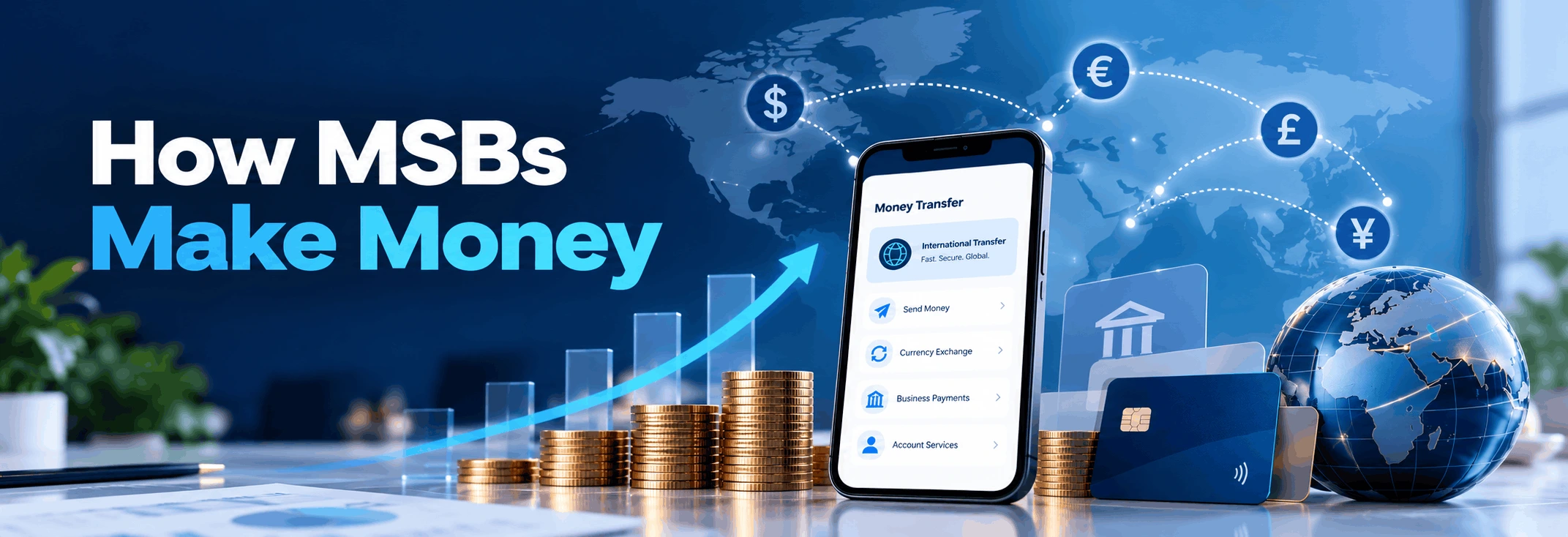
MSBs may combine transaction fees, foreign exchange spreads, account-related fees, eligible virtual currency conversion charges and additional permitted service fees. The actual mix depends on the company’s customers, products, contracts and regulatory permissions. Crucially, payment volume is not revenue: a company processing $10 million of transfers has not earned $10 million.
1. Transaction Fees: Revenue From Money Transfers
A business may charge a fixed amount per transfer, a percentage of the amount sent, or a combination. For example, 10,000 chargeable transfers at an average fee of $3 produce $30,000 in gross fee revenue. Fixed fees are simple to understand, while percentage-based pricing can increase revenue with transfer size. Tiered pricing can vary by corridor, payment method, customer segment and volume. Provider and processing costs must still be deducted.
2. Foreign Exchange Spreads
An FX spread is the difference between the customer exchange rate and the business’s effective execution rate. Suppose a business can effectively exchange USD at 0.920 EUR per dollar but quotes a customer 0.910 EUR. On a $10,000 conversion, the difference is €100 in illustrative gross spread, before liquidity, execution, settlement, hedging and other costs. The relevant base for FX revenue is eligible conversion volume, not automatically all payment volume. A lower advertised transfer fee can coexist with an FX spread, so customers should consider total transfer cost.
3. Account Setup and Monthly Maintenance Fees
Some MSBs offer account-based services and charge one-time setup or recurring maintenance fees where appropriate. For example, 500 paying accounts at $30 per month generate $15,000 in gross monthly account-fee revenue. Subscription tiers can combine standard transfers, business workflows and additional services. Fees should reflect the actual service, be clearly disclosed and comply with applicable rules.
4. Fiat and Virtual Currency Conversion Fees
Where permitted, a business may earn conversion fees or spreads on supported fiat and virtual currency transactions. These services can introduce additional liquidity, custody, operational and regulatory requirements. MSB registration does not authorize every crypto-related activity in every jurisdiction. Each product and market needs its own assessment.
5. Additional Service Fees and Partner Revenue
Depending on the business model, optional services such as priority processing or specialized reporting may generate additional revenue. Some companies also receive contractual referral or revenue-sharing payments from partners, where allowed. Referral income should be distinguished from revenue earned by providing the underlying regulated financial service.
What XlentPay’s CEO Says About MSB Revenue
In a FinHost interview, Joao Monteiro, CEO of XlentPay, discussed transaction fees, account-related charges and foreign exchange as possible monetization mechanisms for a financial services business. The discussion also highlights the importance of reliable banking relationships and operational readiness. These observations are useful context, not a disclosure of XlentPay’s actual pricing or financial performance. Watch the full FinHost and XlentPay interview and explore the XlentPay customer case study.
MSB Revenue & Profit Calculator
Adjust the illustrative assumptions to estimate revenue, operating profit, margin and break-even transaction volume. Figures are not FinHost prices or XlentPay financial results.
Estimated results
Revenue mix
*Break-even transfers hold FX volume, paying accounts and all other inputs constant, and vary only the number of transfers. If per-transfer contribution is zero or negative, the result may be unavailable. This is an illustrative operating model, excluding taxes, financing, customer acquisition, working capital and unmodeled costs.
MSB Revenue vs. Profit: Understanding the Difference
Gross revenue includes the fees and spreads actually earned, not the funds transferred for customers. Operating profit deducts relevant costs, including banking and payment providers, technology, compliance, verification, staff and support. A model should distinguish variable costs that rise with activity from fixed costs. The interactive calculator below makes these relationships easier to explore.
How to Calculate MSB Revenue and Profitability
Transaction-fee revenue equals chargeable transactions multiplied by average collected fee. Gross FX revenue equals eligible FX volume multiplied by the effective gross FX revenue rate. Account-fee revenue equals paying accounts multiplied by average monthly account fee. Operating profit equals total modeled revenue minus variable and fixed operating expenses. For a realistic forecast, calculate different corridors and customer segments separately.
The Role of Technology in MSB Profitability
Software affects processing efficiency, reconciliation, fee configuration, customer onboarding and integration management. Consistent transaction records and configurable pricing can reduce avoidable manual work. Appropriate integrations with banking, payment and verification providers can support operational workflows, subject to provider approval. Technology cannot replace required compliance processes or financial partnerships.
Building vs. Buying MSB Software
A proprietary platform offers architectural control but requires substantial development, testing and ongoing support. White-label fintech software provides an existing foundation that can shorten technical implementation. The right choice depends on total cost of ownership, customization, internal expertise and time to market. See our related guide on building vs. buying fintech software.
How FinHost Supports MSB Business Models
FinHost offers white-label core banking and digital banking software with account management, transaction workflows, Back Office functionality and integrations with external financial infrastructure providers. Depending on configuration and partner capabilities, these tools can support different account, payment and currency exchange workflows. FinHost offers SaaS-based deployment and source code licensing. Software does not itself provide regulatory authorization or guarantee banking relationships.
Five Ways to Improve MSB Profitability
Segment pricing: Evaluate retail, SME and high-volume business customers separately. Analyze corridors: Measure actual revenues and costs by currency pair and destination. Review provider terms: Compare reliability and coverage as well as fees. Automate carefully: Reduce avoidable manual work without bypassing controls. Track contribution margin: Focus on revenue less directly attributable costs, not transaction volume alone.
Conclusion
MSBs can earn revenue from payment fees, FX spreads, account charges and additional permitted services. Sustainable profitability depends on how these revenues compare with processing, banking, technology, compliance and operational costs. A well-designed financial model helps founders decide which customers, corridors and services can support long-term growth. Explore FinHost to discuss the technology foundation for your financial services business.
Frequently Asked Questions
How do money services businesses make money?
Through permitted transaction fees, FX spreads, account charges, conversion services and selected additional services or partner arrangements.
Are money transfer businesses profitable?
They can be, but profitability depends on pricing, transaction mix, banking costs, technology, compliance and customer acquisition.
What is the main revenue source for an MSB?
There is no universal answer. Some rely on transaction fees, others on FX spreads or a mix of fees and recurring account revenue.
How do MSBs earn money from currency exchange?
By capturing a gross difference between the customer rate and effective execution rate, subject to execution and provider costs.
Does FINTRAC MSB registration allow a company to operate as a bank?
No. FINTRAC registration is not a banking licence or authorization for every financial service.
What costs should an MSB model include?
Banking and processing, FX execution, verification, compliance, technology, staff, support and other operating expenses.
Build a Stronger Foundation for Your MSB
Discuss your financial product, revenue model and technology requirements with FinHost.
Get in touchRegulatory references: FINTRAC and FinCEN. Definitions and obligations vary by jurisdiction.