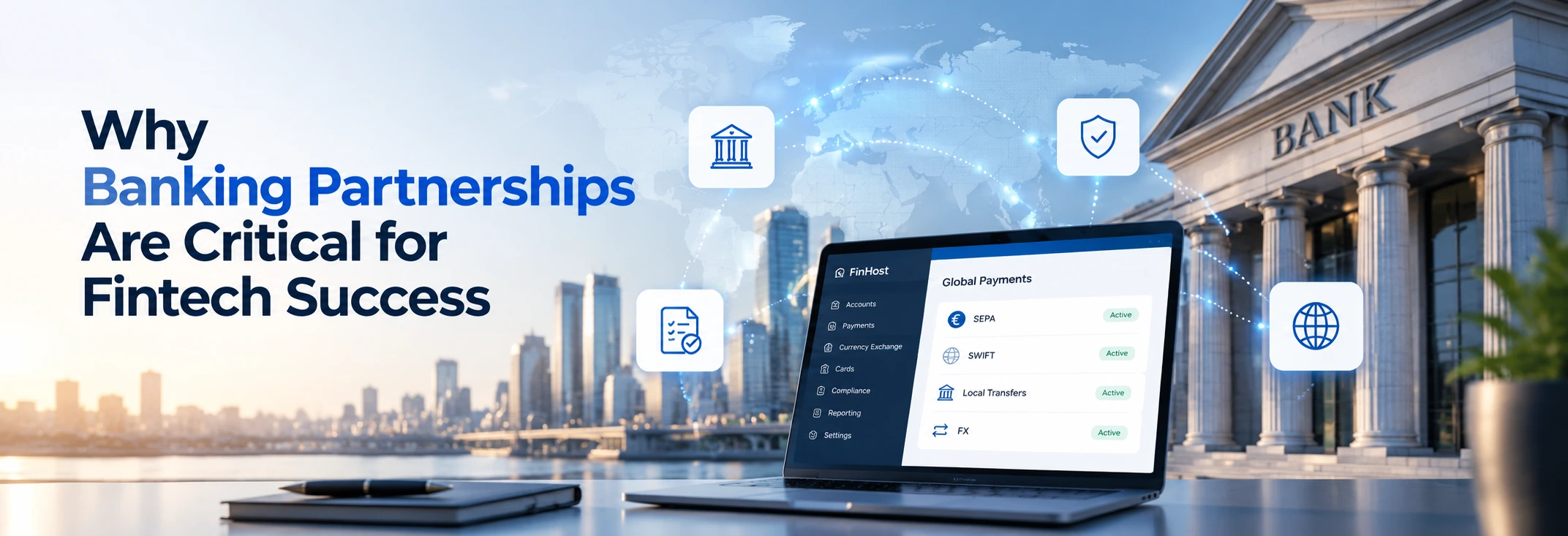
Why Banking Partnerships Are Critical for Fintech Success
November 9, 2026


Fintech Infrastructure Banking Partnerships
A fintech business can have a compelling product and growing customer demand, but without suitable banking and payment partners, it may struggle to move money reliably. Here is how banking relationships, compliance, and technology work together, with insights from XlentPay CEO Joao Monteiro.
Launching a fintech company involves more than building an app, obtaining regulatory registration, or attracting customers. Behind each payment experience is an operational network connecting financial institutions, payment systems, compliance processes, and technology.
For money services businesses (MSBs), payment institutions, electronic money institutions (EMIs), and other fintech providers, banking partnerships are often essential to delivering financial services at scale. Understanding how to establish and maintain these relationships is a critical part of building a sustainable business.
What Are Banking Partnerships in Fintech?
A fintech banking partnership is a commercial relationship through which a financial technology company accesses services provided by a bank or another regulated financial institution. Depending on the business model, jurisdiction, and contractual arrangements, these services may include:
- Business and settlement accounts
- Domestic and international payment processing
- Access to payment schemes and clearing infrastructure
- Multicurrency accounts and foreign exchange services
- Safeguarding arrangements, where applicable
- Banking APIs and transaction reporting
Some fintech companies establish direct relationships with banks. Others access financial services through licensed payment institutions, banking-as-a-service (BaaS) providers, or regulated intermediaries.
Why Are Banking Partnerships Essential for Fintech Companies?
Access to payment infrastructure
Fintech applications generally need an eligible bank, payment institution, or other authorized participant to access the relevant payment systems.
Reliable transaction processing
Payment partners influence settlement, exception handling, transaction status reporting, and operational continuity.
Cross-border expansion
New markets introduce additional currencies, payment rails, regulatory requirements, and customer eligibility considerations.
Business resilience
Thoughtful provider selection and feasible contingency arrangements can help businesses manage concentration risk.
Access to payment networks
Depending on their products and markets, fintech companies may need access to SEPA, SWIFT-based transfers, domestic payment networks, local collection services, or currency conversion and settlement. Availability depends on the capabilities, eligibility rules, and agreements of the underlying providers.
Reliable operations and customer trust
Customers expect accurate processing, transparent statuses, predictable settlement, and timely resolution of failed or delayed payments. Banking and payment partners influence these outcomes through their processing capabilities and operational procedures.
Expansion without assuming universal coverage
An existing relationship may not automatically support every country, payment corridor, customer category, or business activity. International growth requires a fresh assessment of partner coverage, regulatory permissions, and technical readiness.
Why Banking Partnerships Can Be Difficult for MSBs
Money services businesses can face extensive due diligence when seeking banking relationships. Banks need to understand the activities, customers, geographic exposure, expected transaction patterns, and financial crime risks associated with the businesses they serve.
Regulatory guidance supports a risk-based approach rather than treating every MSB as presenting the same risk. However, an individual provider may still determine that a particular business model is outside its commercial or risk appetite.
| Area | Typical assessment |
|---|---|
| Regulatory status | Applicable registrations, licenses, and permitted activities |
| Ownership | Corporate structure, beneficial owners, and management |
| Business model | Products, customer segments, and revenue sources |
| Geographic exposure | Countries served and payment corridors |
| AML/CTF controls | Risk assessment, monitoring, screening, and escalation |
| Customer onboarding | KYC/KYB procedures and customer acceptance policies |
| Transaction activity | Expected volumes, values, currencies, and payment types |
| Operational readiness | Security, reconciliation, incident management, and reporting |
Preparing clear documentation does not guarantee approval, but it can make onboarding more structured and transparent.
Compliance: The Foundation of Stable Banking Relationships
Compliance is more than a regulatory cost. For fintech companies, it also plays a commercial role: helping businesses manage risk and demonstrate to banking partners that their operations are appropriately controlled.
Compliance is key, I would say.
When asked for his most important advice to entrepreneurs launching an MSB, Monteiro explained that compliance matters for two reasons: protecting against wrongdoing and supporting ongoing relationships with underlying banks.
It’s also the key to secure ongoing and stable banking relationship with your underlying banks.
Monteiro acknowledged that strict compliance requirements may mean declining certain customers or losing short-term opportunities. Nevertheless, the long-term value of a stable banking relationship can outweigh revenue from activities that fall outside a company’s acceptable risk profile.
What does ongoing compliance involve?
- Customer identification and verification
- Business verification and beneficial ownership checks
- Sanctions and other required screening
- Transaction monitoring and escalation procedures
- Recordkeeping, reporting, and auditability
- Periodic reviews and clearly assigned responsibilities
Requirements vary by jurisdiction and activity. As a business adds products, enters new markets, or processes higher volumes, its risk assessment and controls may need to evolve.
How Banking Partnerships Support Cross-Border Payments
Cross-border payments show why financial partners and reliable technology need to work together. Consider a business customer sending EUR to a supplier who needs GBP. Depending on the operating model, the process may involve:
- Payment initiationThe customer submits a transfer through the fintech interface.
- Validation and controlsThe platform checks the instruction and applies relevant operational controls.
- Compliance checksRequired screening and monitoring take place under the applicable arrangements.
- Provider processingAn authorized banking, payment, or FX provider performs the relevant financial operations.
- Status updatesThe provider returns processing and settlement information.
- Customer visibilityThe fintech platform displays the updated transaction status.
Not every transfer follows this exact sequence, and responsibilities differ by provider. The principle remains: the customer-facing application and underlying financial infrastructure must operate together.
Banking API Integration: Connecting Fintech Software With Financial Institutions
After establishing a banking or payment relationship, a fintech company needs technical connectivity. APIs allow authorized systems to exchange information and execute supported operations, such as payment initiation, balance retrieval, transaction status updates, statements, and reconciliation data.
Illustrative architecture only. Actual integrations, responsibilities, and transaction flows depend on the provider and project.
What makes an integration reliable?
Authentication, credentials, access controls, and encryption.
Clear treatment of rejections, delays, retries, and unknown outcomes.
Accurate updates based on provider transaction information.
Comparing internal records with provider statements and balances.
Visibility into failures, exceptions, and operational incidents.
Maintaining compatibility with API and provider requirement changes.
Customer perspective · XlentPay
XlentPay’s Experience: Why the Right Technology Partner Matters
Joao Monteiro, CEO of XlentPay, discussed the trade-offs between building fintech software internally and partnering with an established technology provider during an interview with Platon Mykhalchuk, CEO and Co-founder of FinHost.
Monteiro explained that founders should minimize fixed costs and technical uncertainty at the beginning, allowing the business to focus on bringing a reliable product to market and attracting customers.
In every business that I set up, I always started by partnering up with a reliable and solid technology partner.
What XlentPay’s CEO said about FinHost
Monteiro specifically highlighted the flexibility of the technology FinHost provided to XlentPay:
This flexibility from the technology provider that you guys also were able to offer us made a big difference for us, and we are very happy with how things are.
He also thanked FinHost for its ongoing support:
Also, I want to thank obviously Finhost for all the support that you’ve been giving in the last couple of years.
His comments illustrate that technology partnerships extend beyond initial implementation. Flexibility and continuing support can help fintech businesses concentrate on customer acquisition, banking relationships, and growth.
Guest: Joao Monteiro, CEO of XlentPay · Host: Platon Mykhalchuk, CEO & Co-founder of FinHost
How to Choose the Right Banking Partner for Your Fintech Business
Selecting a banking partner requires more than comparing transaction fees. A provider may offer competitive pricing but lack support for your markets, payment methods, customer categories, or expected volumes.
| Criterion | Questions to ask |
|---|---|
| Geographic coverage | Which countries and payment corridors are supported? |
| Customer eligibility | Does the provider support our model and customer segments? |
| Regulatory compatibility | Are our permissions compatible with the proposed arrangement? |
| Payment methods | Which local and international payment rails are available? |
| Currencies | Which currencies can customers send, receive, or hold? |
| Pricing | What are setup, monthly, transaction, FX, and exception fees? |
| API capabilities | Which operations can be automated? |
| Settlement | What cut-off times, schedules, and restrictions apply? |
| Compliance | What onboarding and ongoing controls are required? |
| Support and SLA | How are incidents escalated and service levels measured? |
| Continuity | What happens if the relationship or service ends? |
| Scalability | Can the provider support future volumes and products? |
Should fintech companies work with multiple banking partners?
Multiple providers can expand geographic coverage and reduce dependence on a single relationship, where technically and commercially feasible. But each additional provider introduces more due diligence, integration work, reconciliation, and support requirements. Diversification should be planned around real business-continuity needs, not simply the number of connected banks.
The Role of White-Label Fintech Software in Banking Partnerships
White-label fintech software can provide a technology foundation for companies that do not want to develop every operational component internally. Depending on the platform, this may include customer applications, account and wallet management, transaction records, payment workflows, back-office administration, KYC/KYB integrations, reporting, and external provider APIs.
These components help coordinate customer interactions and operational processes. They do not replace regulatory permissions, banking agreements, or compliance responsibilities.
For founders evaluating their options, see Build vs. Buy: Should You Develop a Fintech Platform or Use White-Label Software?
How FinHost Supports Banking and Payment Integrations
FinHost provides white-label core banking and fintech software to help financial services businesses manage digital products and connect with external providers.
Provider integrations
Connect supported banking and payment services to configurable fintech workflows, subject to provider availability and agreements.
Explore BaaS & API integration →Deployment flexibility
Explore SaaS and hybrid approaches based on operational and technical requirements.
Explore SaaS & Hybrid →Software control
Consider source-code licensing where greater technical control is required, subject to license terms.
Explore source code licensing →As XlentPay’s experience illustrates, a flexible technology partner can help founders direct more resources toward customers, commercial development, and banking relationships.
Connect your fintech vision with the right technology.
Discuss your platform requirements, provider integrations, and deployment model with the FinHost team.
Five Recommendations for Sustainable Fintech Partnerships
- Define your banking requirements first. Identify the countries, currencies, payment methods, customer segments, and volumes you need.
- Make compliance part of your commercial strategy. Build controls that reflect your model and applicable obligations.
- Evaluate operations, not only price. Settlement, exception handling, reconciliation, and support matter.
- Choose adaptable technology. Consider integration flexibility, security, reporting, and ongoing maintenance.
- Plan for business continuity. Understand how interruptions or relationship changes could affect customers.
Frequently Asked Questions
Why do fintech companies need banking partners?
Many fintech companies rely on banks or other regulated financial institutions to access payment systems, settlement services, accounts, or other financial infrastructure. The exact requirements depend on the company’s products, regulatory status, and operating model.
Can an MSB operate without a banking partner?
Banking needs vary by activity and jurisdiction. Many digital payment and money transfer models require banking or regulated payment infrastructure to function effectively, even where the MSB has its own registration.
How can an MSB establish a banking relationship?
Identify providers that support your business model and prepare documentation on regulatory status, ownership, services, markets, expected transaction activity, and compliance controls. Approval remains subject to each provider’s due diligence and risk assessment.
Why is compliance important for banking partnerships?
Compliance helps manage financial crime risks and demonstrate appropriate controls to financial partners. It can support more sustainable relationships, although it does not guarantee access to banking services.
What is a banking API integration?
It is a technical connection that enables authorized systems to exchange data or perform supported operations with a bank or financial provider, such as payment initiation, balance retrieval, transaction updates, or reporting.
Can a fintech company integrate multiple banking providers?
Yes, where supported by technology, agreements, regulatory arrangements, and provider eligibility. Multiple connections may improve coverage but also increase operational complexity.
Does white-label fintech software include a banking license?
No. Software functionality, regulatory authorization, and banking access are separate matters governed by applicable laws and provider agreements.
How does FinHost help with banking integrations?
FinHost provides configurable fintech software and integration capabilities. Businesses can explore supported provider connections and discuss additional requirements, subject to the relevant provider arrangements.
Conclusion: Fintech Success Depends on More Than Technology
Banking partnerships are fundamental to many fintech business models. They provide access to financial infrastructure, support payment operations, and influence which markets and services a company can serve.
Yet banking access alone is not enough. Businesses also need effective compliance processes, dependable technology, and operational capabilities to serve customers consistently.
Joao Monteiro’s experience at XlentPay reinforces this connection. His advice to prioritize compliance highlights the importance of stable banking relationships, while his comments about FinHost demonstrate the value of flexible technology and ongoing support.
Reliable banking relationships, strong compliance, and adaptable technology form the foundation of a more resilient fintech business.
References & Further Reading
- FinCEN: Guidance on MSBs Obtaining and Maintaining Banking Services
- Federal Reserve: Guidance on Providing Banking Services to MSBs
- FinHost and XlentPay Customer Story
- FinHost: Interview with Joao Monteiro, CEO of XlentPay
Editorial note: Direct quotations follow the supplied interview transcript and should be checked against the video before publication.